
Ultracab India Ltd right issue 2025 - apply or not?


Ultracab India's  rights issue has been released, priced at 14.50 rupees. 

This is expected to generate roughly 50 crores for the company, with the ratio being with 9 shares will be allotted for 25 existing shares.

Looking at the financial data, we see that Ultracab India's sales in September 2024 amounted to 55.55 crores, with the sales figure for the last financial year 2024,  being 124 crores.

If we look at the balance sheet, as of March 2024, there were 52 crore worth of external borrowings, which was 17 crores higher than the March 2023 borrowings of 35 crores, most of which were long term borrowings.


From Ultracab's financial year 2024 annual report, it is clear that the major loan is from Axis Bank and other smaller loans, like a car loan, are from HDFC Bank.

Ultracab India Ltd’s current ratio in financial year 2024 was 2.86, which had increased from 1.60 in 2023, which is positive.


The debt to equity ratio also changed from 1.05 in 2023 to 1.34 in 2024 due to repayment of Non-Current Borrowings.

The major portion of all large loans is a loan from the director, while the bank loan has been reduced.

There are also quite related party transactions.

Such as with Jigar Cables Limited, Jigar Polymers Limited, Ultracab Tradelink etc. which are to be considered as red signal.

Right issue details-

The rights issue will open on the 28th of January 2025 and close on the 11th of February 2025, with the record date set as the 16th of January 2025.

The credit ratings of Ultracab India Ltd. have just been improved by Infomerics a few days ago, which is a good thing. Readers can download the rating document from below link-

https://www.bseindia.com/xml-data/corpfiling/AttachHis/4f295d17-db37-47d1-8188-b0813e51baea.pdf
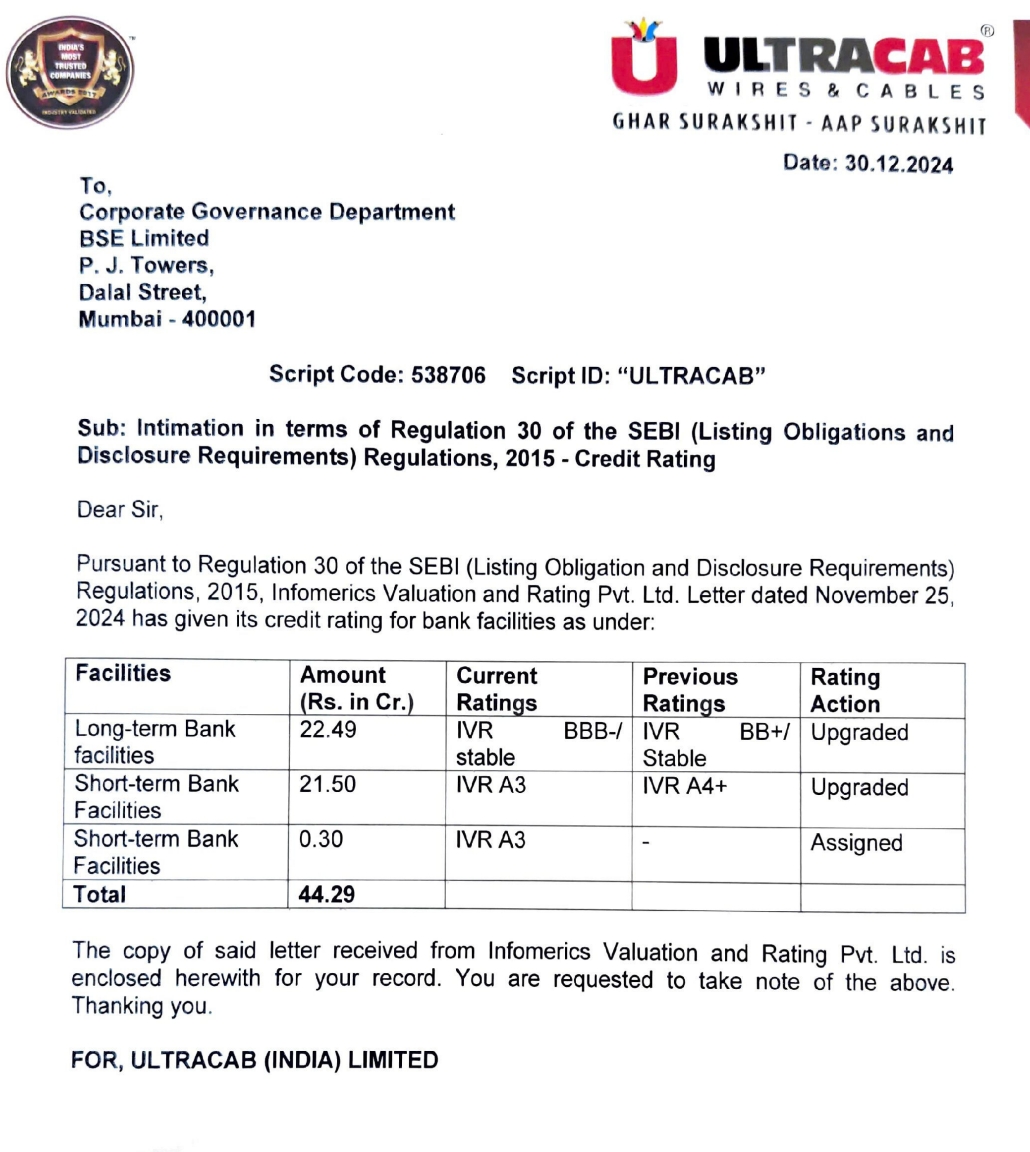
ultracab india ratings
Ultracab india ratings

So, looking at the pros and cons and the price of the 14.50 right issue, as well as comparing the valuation with peers, I personally believe it is a good idea to subscribe to this, with a long-term view of at least 5 years.

But it is necessary to pay attention to financial results every quarter.

Be sure to consult with your financial advisor as this is not financial advice, these are personal views.


Thank you.

Dustfinance

Joindustfinance@gmail.com

www.dustfinance.in

Popular posts from this blog

Joint Ventures, Subsidiaries, and Associates – A Complete Guide for Investors & Business Owners

Joint Ventures, Subsidiaries, and Associates – A Complete Guide for Investors & Business Owners When analyzing any company — whether for investment , business strategy , or financial reporting — you will often come across terms like Joint Venture , Subsidiary , and Associate Company . Understanding these concepts is crucial because they directly impact a company’s profitability, control, risk exposure, and valuation . Let’s break them down in simple language with examples and investor insights. 1️⃣ What is a Joint Venture (JV)? A Joint Venture (JV) is a business arrangement where two or more companies come together to start a new project or entity , sharing ownership, risks, and profits. Key Features: Shared ownership (often 50:50 or agreed ratio) Shared control Shared profits & losses Created for a specific purpose or project Example: Sony Ericsson was a joint venture between Sony and Ericsson to manufacture mobile phones. Both companies combined t...

Joint Ventures vs Subsidiaries vs Associates: Complete Guide for Smart Investors (With Examples)

Joint Ventures vs Subsidiaries vs Associates: Complete Guide for Smart Investors (With Examples) Understanding the difference between Joint Ventures (JV), Subsidiaries, and Associate Companies is extremely important for investors, stock market participants, and business owners. These structures impact financial statements, control, risk exposure, and valuation. If you analyze companies like Tata Sons , Reliance Industries Limited , or Hindustan Unilever Limited , you’ll often find a mix of subsidiaries, joint ventures, and associates in their annual reports. Let’s break everything down in a simple, investor-friendly way. 1️⃣ What is a Subsidiary Company? ✅ Control Criteria: 📌 Key Features: 🔎 Example: 2️⃣ What is an Associate Company? ✅ Ownership Criteria: 📌 Key Features: 🔎 Example: 3️⃣ What is a Joint Venture (JV)? ✅ Key Conditions: 📌 Key Features: 🔎 Example: 4️⃣ Key Differences (Comparison Table) Basis Subsidiary Associate Joint Venture Ownership >50% 20–50% Shared Contr...

free Stock Market Fundamental Analysis

Stock Market Fundamental Analysis क्या होता है फंडामेंटल एनालिसिस ?आखिर क्यों कुछ शेयर सस्ते और कुछ महंगे मिलते हैं? फंडामेंटल एनालिसिस एक तरीका है लिस्टेड शेयर्स का असली भाव पता करने का,जैसा की आप सबको पता है की जितने भी शेयर्स शेयर बाजार में है और स्टॉक एक्सचेंज पर ट्रेड होते है,आप देखते होंगे की किसी शेयर का भाव 250 रुपया है,किसी का भाव 10 रुपया है और किसी का भाव 20000 रुपया है| क्यों ऐसा होता है? क्यों हम सब ज्यादातर 10  रुपया के शेयर को सस्ता मानते है बजाये 20000 के शेयर के ? क्यों 20000 का शेयर 21000 का भी हो जाता है जबकि 10 रुपया का शेयर 8 रुपया का रह जाता है? 👉 हम 10 रुपया का शेयर खरदीना ज्यादा सही समझते है,  क्युकी 1000 रुपया के 100 शेयर आएंगे और अगर 10 रुपया का शेयर 15 रुपया जाता है तो 5000 का लाभ देगा , वही 20000 का शेयर पहले तो 1000 का मिलेगा ही नहीं और अगर 20000 का लेते हैं तो 21000  का भी होगा तो मात्रा 1000 देगा | यही सोच है न हम सबकी?  कभी आपने सोचा की वह 20000 का शेयर बहुत साल पहले 50 रुपया का ही था| तो क्या आपका 10 रुपया का शेयर भी कुछ सालों बाद 10...